Compared, from their own pages
Automatic mastering services, compared on what they publish.
LANDR, eMastered, BandLab, Mixea, Masterchannel, Aria and CloudBounce, read from each vendor’s own pages on 19 September 2026: pricing pages, help centres and blogs. Every cell is a quote, a summary of a page linked below, or says “not published”. Where a service gives you something this one does not, the row says so.

The table.
Scrolls sideways →
| What | Bounce Sessions (staging) | LANDR | eMastered | BandLab | Mixea | Masterchannel | Aria |
|---|---|---|---|---|---|---|---|
| Cheapest paid plan | $15/mo, or $99/yr | “$8.25/month” “Billed yearly” (Essentials) | “$15/mo” “Yearly: $180 billed upfront” | Mastering is free; paid presets need Pro, “$14.99/month” or “$99/year in the first year” | “$8.25 /mo $99 billed annually” | “$15 / mo. billed as $180/year” (Artist) | “$49/Month” for “10 Songs per Month” |
| One track, no subscription | $4.99 | “$10 to master a single track” (16-bit WAV; 24-bit HD WAV $20) | “does not currently offer individual file downloads” | Not sold; the tool is free with an account | A per-track fee when you upload through DistroKid; amount not published | Not published | “$9.90/Master” |
| What is free | Full-length previews and every measurement, 20 masters a day; no download | “unlimited free mastering previews”; a 3-day trial of the plans | “completely free to test”; pay to download | Free presets, “unlimited WAV and MP3 downloads” | “Your first mastered track is free” | A preview before payment, “solely for evaluation purposes”; limits not published | A 15-second preview; “The first five previews are free” |
| Lossless WAV on the cheapest paid plan | Yes — 24-bit at the source rate, plus 16-bit and MP3 | No — Essentials is “Unlimited MP3 masters” | Yes — “every file type” | Yes — WAV on the free tier | Yes — “HD WAV, 24 bit depth, 48k sample rate” | Yes — “returned as a Lossless WAV file” | Yes — “16bit 44.1kHz WAV files and 24bit 44.1kHz WAV files” |
| Loudness control you set | Four LUFS targets at a −0.1 dBTP ceiling, chosen per job | “Low”, “Medium”, “High” | A strength control, EQ, width and a volume fader (paid plans) | Input gain or Auto Gain; “Light, Normal, and Heavy” intensity (Pro) | “Low, Medium, and High” | A pre-limiter Gain control (beta); no LUFS target | Mix Types “A” to “E” |
| Prints the loudness it achieved | Yes — the input and the delivered file, both labelled | Not published | Not published | Not published | Not published | Yes — an analysis view “for songs mastered with Masterchannel” shows integrated and short-term LUFS | Not published |
| Says when a target is out of reach | Yes — the shortfall in LU, and the file is still delivered | Not published | Not published | Not published | Not published | Not published | Not published |
| Preview listening level | Actual mix and mastered levels | “Volume Match”; its help article says “included with all Advanced and Pro plans”, plan names LANDR no longer sells | A preview; level matching not published | Not published | Waveforms for both; level matching not published | Before and after toggle; level matching not published | A 15-second section |
| Bundled extras | The Release Planner for every release, with exports and file references | Distribution, samples, plugins, courses | Distribution, stem separation, plugins | Distribution (Pro and Max); beats and sounds, with a small free allowance | None | Album, bulk and batch mastering, storage; white-labelling on Partner | Free remasters, five per song |
Every competitor cell was read from the vendor’s own pages on 19 September 2026, at US pricing, and the sources are linked in each section below. LANDR’s and eMastered’s pricing pages are JavaScript shells, so their prices were read from the price data those pages load. Prices move and plans get renamed; check them before you decide. “Not published” means the pages we read do not state it, not that the feature does not exist. CloudBounce has closed and has its own section.
Read 19 September 2026
LANDR
Three LANDR Studio tiers, all with unlimited MP3 masters; WAV starts at Standard (“$12/month Billed yearly”, “Unlimited MP3 + 36 WAV masters”, 16-bit) and is unlimited, with 24-bit HD WAV, at Pro. A single WAV master is $10 with no subscription; LANDR’s price data lists an MP3 master at $6 and an HD WAV at $20. Loudness is one of three words, Low, Medium or High, and the help centre prints no LUFS or true-peak figure for any of them. The one figure LANDR does publish is a recommendation: “we recommend ensuring that your music does not exceed -14 LUFS.” A search of its help centre for “LUFS” returns that one article, and none states what loudness a finished master reached.
In their words
- “You can try any subscription tier of LANDR Studio free of charge for a period of 3 days.”
- “It costs $10 to master a single track with LANDR.”
- “LANDR offers 3 mastering loudness settings” — Low, Medium, High
- “Our 16bit WAV masters come back with a sample rate of 44.1kHz. If you opt for our 24bit HD WAVs, you’ll keep whatever sample rate you had in your original file.”
- “Volume Match lets you compare your original and master with more accuracy.”
- “Remastering a track with different settings (style and/or loudness) will cost an additional credit.”
- “we recommend ensuring that your music does not exceed -14 LUFS.”
Read 19 September 2026
eMastered
A subscription with no single-track option: “eMastered is a subscription service for musicians, and does not currently offer individual file downloads at this time.” Previews are free and unlimited, and the yearly plan is $180 up front. On paid plans the controls are a strength setting, an EQ with three bands (Low, Medium and High), a width setting and a volume fader; no LUFS target or true-peak ceiling is offered, and no achieved loudness is printed. Refunds run 14 days and fewer than four downloads.
In their words
- “eMastered is completely free to test … You are only asked to pay if you wish to download an eMastered mastered version of a song you upload.”
- “does not currently offer individual file downloads at this time.”
- “You can adjust the mastering strength, EQ, Stereo Width and Volume”
- “eMastered has a 14-day refund policy.”
- “HD Wav’s offer downloads at 24 bit with sample rates higher than 44.1Khz, and can go up to 96k.”
Read 19 September 2026
BandLab Mastering
Free with a BandLab account: the Universal, Fire, Clarity and Tape presets and “unlimited WAV and MP3 downloads”. Natural, Spatial, Cinematic and Punch, plus a three-step Intensity, need a membership, and reference matching needs the Max tier. The help centre describes an input gain (or Auto Gain), but no LUFS target, no true-peak ceiling and no loudness readout; the one level figure in it is advice about the mix you upload. The mastering page itself is a JavaScript shell, so its own copy could not be read.
In their words
- “Unlimited Downloads: Master as many tracks as you want and get unlimited WAV and MP3 downloads.”
- “A Pro Membership enables you to adjust the Intensity of the Mastering Preset into three levels: Light, Normal, and Heavy.”
- “Aim for your pre-mastering mix to sit between -8 dB and -4 dB.”
- Pro: “3-day free trial, automatically renews at $14.99/month”; annual “$99/year in the first year, then $149/year”
- “Reference Mastering is exclusive to Max Membership.”
Read 19 September 2026
Mixea (DistroKid)
One plan: “Unlimited mastering for $8.25 /mo $99 billed annually”, with the first track free. Fifteen options per upload, from three intensities (“Low, Medium, and High”) and five EQ settings; no loudness figure, no ceiling, no printed result. Files above 48 kHz are downsampled before mastering. A per-track price is offered when you upload through DistroKid, and its amount is not published: “This type of Mixea pricing is a per-track fee, so make sure you review the full price”.
In their words
- “Your first mastered track is free. After that, only $99/year for unlimited mastering.”
- “The available options for Intensity are Low, Medium, and High.”
- “Ultra HD: HD WAV, 24 bit depth, 48k sample rate”
- “Anything higher than 48 kHz will be downsampled to 48 kHz prior to mastering.”
- “many streaming services may change the loudness of your mastered tracks, but some may not”
- “This type of Mixea pricing is a per-track fee”
Read 19 September 2026
Masterchannel
Three yearly plans from “$15 / mo. billed as $180/year”, with album, bulk and batch mastering on every tier and white-labelling on Partner. Files come back as lossless WAV, at the source bit depth for a lossless upload. Tone is steered by genres, moods and up to three reference tracks, and a beta adds Lows, Mids, Highs, Gain and Stereo controls; there is no LUFS target or ceiling to set. The blog describes a target of “around -9 to -11 LUFS” for the loudest part of a track, and an analysis view “for songs mastered with Masterchannel” shows integrated and short-term LUFS. Its terms describe a preview before payment, “solely for evaluation purposes”; the pricing page describes no free tier.
In their words
- “$15 / mo. billed as $180/year”
- “all processed files are now returned as a Lossless WAV file”
- “Reference Tracks: Add up to three reference tracks to guide the system’s sonic target.”
- “Gain: Reduce or boost the overall volume before limiting.”
- “We just launched our new analysis feature for songs mastered with Masterchannel”
- “Any preview, demo, sample, watermarked output, or other processed file made available by Masterchannel prior to payment is provided solely for evaluation purposes.”
- “A key focus is on the loudest part of your track, ensuring it sits around -9 to -11 LUFS”
- “You can get a refund within 14 days of a subscription payment if you haven’t used the service during that time.”
Read 19 September 2026
Aria Mastering
Per-track pricing at “$9.90/Master” and subscriptions from “$49/Month” for ten songs. The preview is a 15-second section, free for the first five and $2 each after. Five Mix Types set the level, from “Moderate” to “Extra Dynamic”; a LUFS-normalised file can be ordered for a fee, with no figure stated. The pricing page says subscriptions run a minimum of three months and the FAQ says one; both are quoted below.
In their words
- “$9.90/Master”
- “Aria allows you to preview a section of the master for free … returns a 15 second section of the master … The first five previews are free.”
- “All mastered files will be supplied as 16bit 44.1kHz WAV files and 24bit 44.1kHz WAV files.”
- “Subscriptions run for a minimum of 3 months”
- “Subscriptions run for a minimum of 1 month”
Closed
CloudBounce
CloudBounce shut down. The domain no longer resolves (no address record on 19 September 2026), and its Zendesk help centre redirects to Zendesk’s “help center closed” page. A June 2025 copy of its login page in the Internet Archive carries the notice: “Dear customers, we deeply regret to inform you that it has been decided to close down CloudBounce business operations permanently as of the 1st of April 2025.” Its final notice, on Image-Line’s site, gives a later date: “CloudBounce as a company has closed its operations permanently June 30th, 2025”, and says “CloudBounce’s mastering technology will live on inside FL Studio DAW as a built-in AI mastering feature”.
If you came here looking for it: the preview on this site is free and full length, the download is $4.99 a track or $15 a month, and every master comes back with its measurements.
Where the published numbers are wrong
LANDR’s blog prints figures the platforms never published.
LANDR’s guide to LUFS metering, updated 18 August 2025, attributes a loudness figure to six platforms. Checked against each platform’s own documentation, four publish no loudness figure at all, Apple publishes one only for Dolby Atmos and surround deliveries, and Spotify publishes a different set of numbers.
Scrolls sideways →
| LANDR’s blog says | The platform itself |
|---|---|
| “YouTube’s normalization standard is around -14 LUFS” | YouTube publishes no loudness figure — it documents a “Stable Volume” setting with no number |
| “TIDAL normalizes to a level of -14 LUFS” | TIDAL publishes no loudness documentation; a help-centre search for “loudness” returns nothing |
| “Amazon Music’s loudness standard is -14 LUFS” | Amazon Music publishes no figure — a how-to for switching normalisation on, and nothing else |
| “Deezer’s standard is at -14 LUFS” | Deezer publishes no figure — a user toggle, documented without a number |
| “Apple Music … roughly corresponds to -16 LUFS” | Apple publishes no stereo loudness figure; its only one is a −18 LKFS ceiling for Dolby Atmos and surround deliveries. −16 appears in none of its documents |
| “Spotify normalizes tracks to -14 LUFS for desktop playback and -11 LUFS for mobile devices” | Spotify publishes three listener settings, Loud −11, Normal −14 and Quiet −19 dB LUFS, with no split by device |
Source: blog.landr.com/lufs-loudness-metering/, read 19 September 2026. What each platform publishes, quoted and linked: the targets page.
What this one does
Two numbers you set, two numbers you get back.
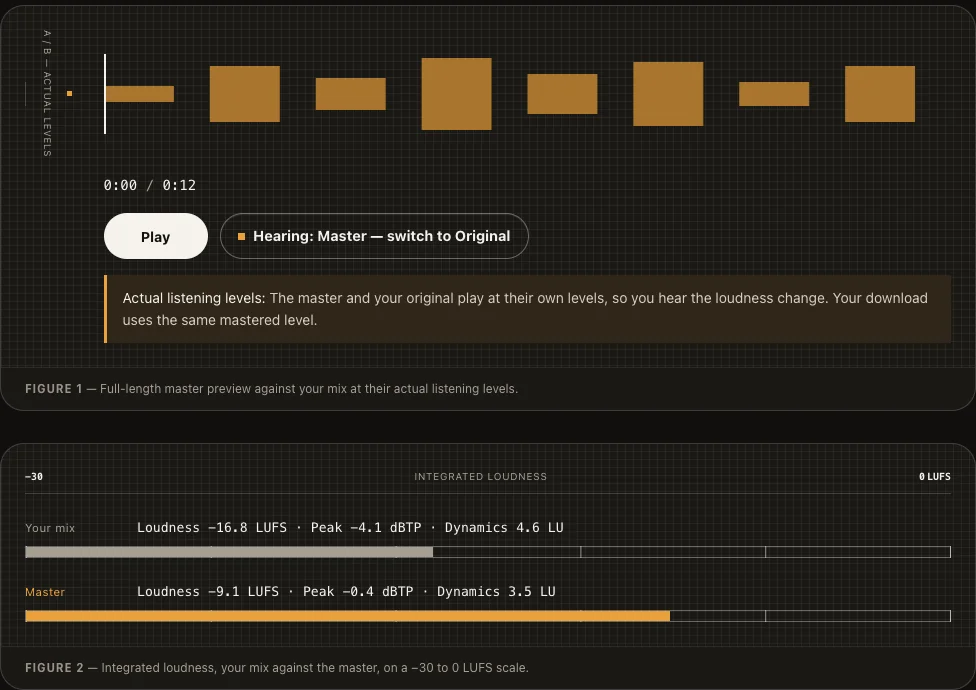
- Four loudness targets, −14 to −8 LUFS
- One true-peak ceiling, −0.1 dBTP, on all four
- Nothing else — the tonal reference is chosen for you
- Your mix measured before anything is touched
- The delivered file measured after rendering
- The shortfall in LU when a target is out of reach
- Nothing to preview, full length, at its mastered loudness
- $4.99 a track, or $15 a month
- Unlimited includes the Release Planner for every release, with exports and file references
- Cancel from your account
Questions
Questions about the comparison.
Which automatic mastering service is cheapest?
For one track with no subscription: this one at $4.99, with WAV and MP3; LANDR at $6 for an MP3 and $10 for a WAV; Aria at $9.90. eMastered does not sell single tracks, Masterchannel publishes no single-track price, and Mixea does not publish the amount. For a yearly plan, LANDR Essentials and Mixea both bill $99 a year, the same as Unlimited here; LANDR’s $99 tier delivers MP3 only. BandLab Mastering is free with an account.
Which one lets me set a LUFS target?
Of the services read, this one. LANDR offers three loudness words; BandLab and Mixea a three-step intensity; eMastered a strength control and a volume fader; Aria five Mix Types; and Masterchannel a gain control in beta. Of the six, only Masterchannel shows the finished master’s loudness, in an analysis view, and none says what happens when a target cannot be reached.
Is BandLab mastering really free?
Yes, with a BandLab account: the Universal, Fire, Clarity and Tape presets and unlimited WAV and MP3 downloads. Natural, Spatial, Cinematic and Punch, plus the three-step Intensity, need a paid membership, and reference matching needs its top tier. Its help centre describes no loudness target and no loudness readout.
What happened to CloudBounce?
It closed. A notice on its own site gave 1 April 2025; its final notice, on Image-Line’s site, gives 30 June 2025 and says the technology lives on as FL Studio’s built-in AI mastering. The domain no longer resolves.
How was this comparison made, and can it be wrong?
Every cell was read from the vendor’s own pages on 19 September 2026 and is quoted or summarised with its source linked. Prices and plan names change; three pricing or product pages are JavaScript shells, so LANDR’s and eMastered’s prices were read from the data those pages load and BandLab’s mastering page could not be read; and a help article can lag the pricing page, as LANDR’s Volume Match article does. Where two of a vendor’s own pages disagree, both are quoted. Check the linked pages before you decide.
Hear it before you compare anything else.
The preview is free and full length at its mastered loudness against your own mix, with both sets of numbers on screen.