Targets
Most of these numbers have no published source.
Spotify and SoundCloud publish −14 LUFS in their own words. Apple, YouTube, TIDAL, Amazon Music and Deezer publish no loudness target for a stereo track — the figures attributed to them come from somewhere else and get repeated. Everything below is quoted and linked.
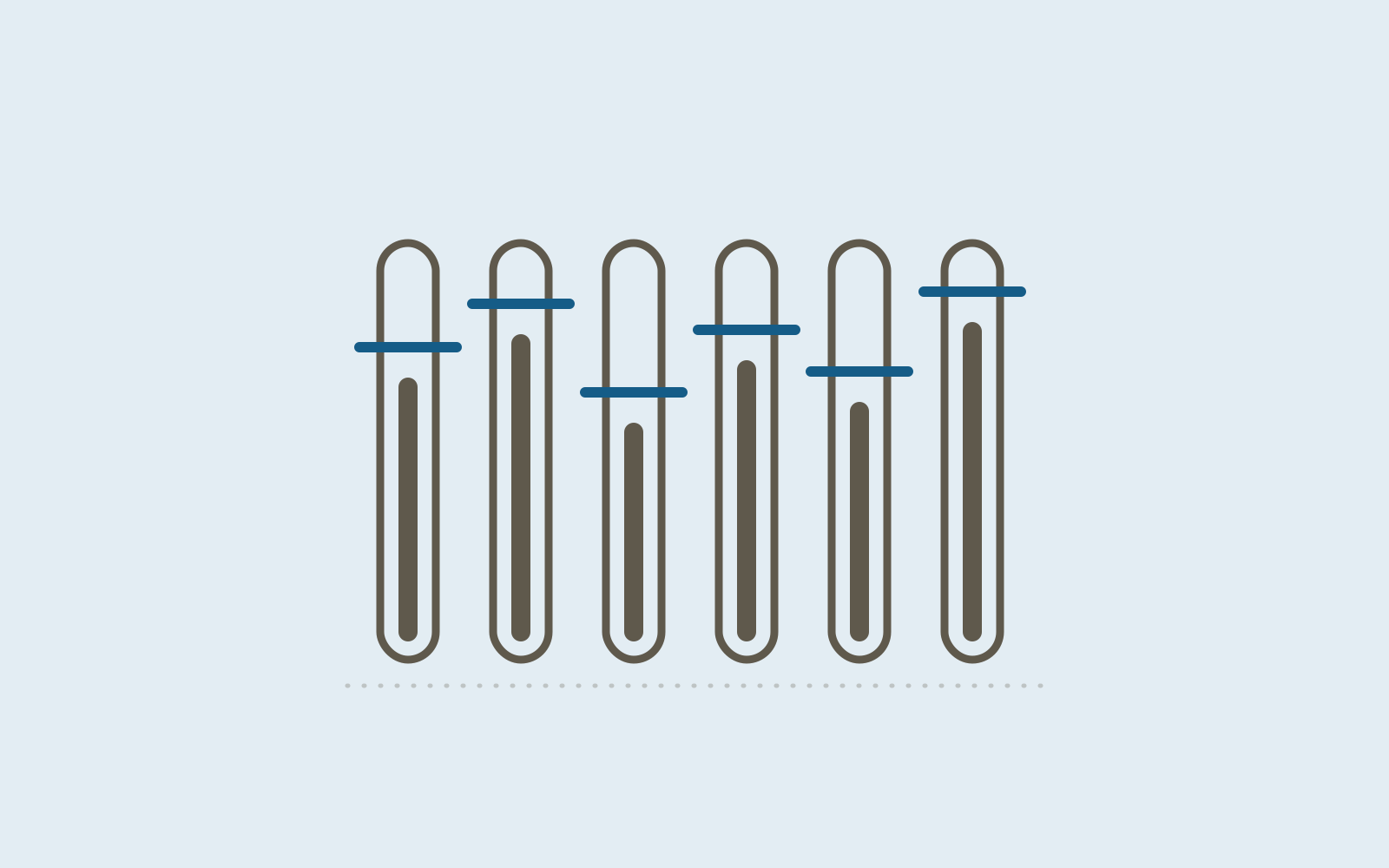
Published figures and our four choices, on one scale
The four marked are the loudness choices you can pick here: −14 and −11 match published Spotify settings, −9 and −8 are ours, not published figures. The other two are on the scale because they are real published numbers, not because we deliver them.
Does the platform publish a number, or not?
What LUFS does Spotify use? Is −14 the official number?
Yes, in Spotify’s own words: “We adjust tracks to −14 dB LUFS, according to the ITU 1770 standard.” It also publishes the three Premium playback settings, Loud at −11, Normal at −14 and Quiet at −19 dB LUFS, and asks that a master louder than −14 LUFS keeps its true peak below −2 dBTP. Spotify in detail. It turns quieter tracks up as well, as far as the true peak allows with 1 dB to spare, and it normalises a whole album with one gain when it is played as an album. Normalisation is off on its web player and on third-party devices.
What LUFS does SoundCloud use?
SoundCloud recommends −14 integrated LUFS: “Target the loudness level of your master at −14 dB integrated LUFS and keep it below −1 dB TP (True Peak) max.” For a louder master it asks for −2 dB TP. It says it applies loudness normalisation as tracks play, but it does not state the level it normalises to.
What LUFS does Apple Music use? Is −16 Apple’s number?
For a stereo track, Apple publishes no loudness figure. Neither the Apple Digital Masters document nor the Sound Check article contains one; the Digital Masters document recommends leaving “at least 1 dB of headroom”. Apple’s asset guide does set limits for Dolby Atmos and 5.1/7.1 deliveries: “The integrated loudness value must not exceed -18 LKFS”, and “True-peak level must not exceed -1 dB TP”. The −16 often attributed to Apple appears in none of these; AES TD1008’s track figure is also −16. Apple Music and Sound Check in detail.
Does YouTube publish a loudness target?
No. YouTube documents a “Stable Volume” setting with no figure, and says it is turned off for YouTube Music and official music videos. The −14 usually quoted for YouTube is not in YouTube’s help documentation. What YouTube does publish.
Does TIDAL publish a loudness target?
No. TIDAL’s help centre has no article on loudness; a search for “loudness” returns zero articles.
Does Amazon Music publish a loudness target?
No. Amazon Music publishes a how-to for switching normalisation on, and no figure.
Does Deezer publish a loudness target?
No. Deezer documents a user toggle for volume normalisation, with no number.
Where does the −16 LUFS track recommendation come from?
AES TD1008, an Audio Engineering Society technical document addressed to distributors of streams: −16 LUFS when a service normalises track by track, −14 for the loudest track of an album when it normalises by album, and a maximum true peak of −1 dBTP at the input of a lossy encoder. It is not a platform, it says it does not make recommendations for content production, and no platform has adopted its −16 in its own documentation.
Checked against each company’s own documentation on 19 September 2026, sources linked under the table below. Measure your own file against these on the loudness penalty calculator.
Who publishes what
Checked against each company’s own documentation on 19 September 2026. Where a row says none published, that is not us failing to find it — it means the document does not contain a figure for a stereo track.
Scrolls sideways →
| Source | Loudness target | True-peak ceiling | In their words |
|---|---|---|---|
| Spotify | −14 LUFS | −1 dBTP −2 above −14 |
“We adjust tracks to −14 dB LUFS, according to the ITU 1770 standard.” And: “If your master is louder than −14dB integrated LUFS, keep True Peak below −2dB to avoid extra distortion.” |
| SoundCloud | −14 LUFS recommended |
−1 dBTP −2 above −14 |
“Target the loudness level of your master at −14 dB integrated LUFS and keep it below −1 dB TP (True Peak) max.” And: “If your master is louder than -14 dB integrated LUFS, make sure it stays below -2 dB TP (True Peak) max to avoid extra distortion.” It says it normalises, and does not say to what level. |
| AES TD1008 | −16 / −14 LUFS track / loudest album track |
−1 dBTP | “For all content, it is recommended that the Maximum True Peak level not exceed −1 dBTP at the codec input of lossy-encoded streams.” |
| Apple | none for stereo | −1 dBTP Atmos, 5.1/7.1 |
For Dolby Atmos and 5.1/7.1 deliveries only: “The integrated loudness value must not exceed -18 LKFS, measured per ITU-R BS. 1770-4. True-peak level must not exceed -1 dB TP, measured per ITU-R BS. 1770-4.” No loudness figure for a stereo music track appears in the asset guide, the Apple Digital Masters document or the Sound Check article. |
| YouTube | none published | none published | Documents only “Stable Volume”, with no figure — and says it is turned off for YouTube Music and official music videos. |
| TIDAL | none published | none published | No help-centre article on loudness. A search for “loudness” returns zero articles. |
| Amazon Music | none published | none published | A settings how-to for turning normalisation on. No figure. |
| Deezer | none published | none published | A user toggle, documented without a number. |
Sources, in order: Spotify for Artists, SoundCloud Help, AES TD1008 v1.21-9, Apple Video and Audio Asset Guide (with Apple Digital Masters and Sound Check), YouTube Help, TIDAL Support search, Amazon Music Help, Deezer Support. Checked 19 September 2026 — platforms change these. Apple revised its asset guide on 8 September 2026.
The listener picks a playback level
Spotify Premium lets a listener choose the playback level, and the three options are published figures. This is why −11 LUFS is on our scale: it is not a compromise between −14 and louder, it is a real endpoint that a real listener can be sitting on.
- −11 LUFS Loud A −11 master gets no gain change. On Loud, Spotify adds a limiter that engages at −1 dB (sample values), with a 5 ms attack and a 100 ms decay.
- −14 LUFS Normal The level Spotify’s documentation says it normalises to, and the number every guide quotes.
- −19 LUFS Quiet Eight decibels below Loud. The same master serves all three.
Choose the loudness
Loudness is a judgement about where your record sits. The ceiling is a technical fact about what happens to the file next. New uploads use one fixed ceiling.
The loudness axis
Where it sits
Four targets, −14 to −8 LUFS. Above −14, Spotify’s default setting plays the master back at −14 — but the limiting stays, and normalisation is off on Spotify’s web player and on third-party devices.
The ceiling axis
The true-peak ceiling
Every current choice uses −0.1 dBTP. For context, −2.0 is what Spotify asks for above −14 LUFS. −1.0 is the general recommendation. −0.1 leaves no room for encoder overshoot at all, so lossy encodes can peak higher than the WAV.
None of the services on our comparison page lets you set a LUFS target; they offer a few named levels, an intensity or a gain fader. Here you choose the number: Dynamic (−14), Balanced (−11), Full (−9), or Extra loud (−8 LUFS).
What people actually ask
How many LUFS should my master be for Spotify?
Spotify normalises to −14 LUFS and says so in its own words: “We adjust tracks to −14 dB LUFS, according to the ITU 1770 standard.” That is what it plays back at, not a rule about how you must master. Spotify also asks that a master louder than −14 LUFS keeps true peak below −2 dBTP.
What LUFS does Apple Music use?
For a stereo track, Apple publishes no loudness figure. Neither the Apple Digital Masters document nor the Sound Check article contains one. Its asset guide sets a −18 LKFS ceiling and a −1 dB TP limit only for Dolby Atmos and 5.1/7.1 deliveries. The −16 LUFS often attributed to Apple appears in none of these documents; AES TD1008’s track figure is also −16.
Which platforms publish a loudness target?
Two, as of 19 September 2026, both at −14 LUFS: Spotify, which normalises to it, and SoundCloud, which recommends it and says it normalises without stating the level. AES TD1008 recommends −16 for track normalisation and −14 for the loudest track of an album, but it is a technical document addressed to distributors, not a platform. For a stereo track, YouTube, TIDAL, Amazon Music, Deezer and Apple publish nothing — TIDAL’s help centre returns zero articles for a search on “loudness”.
Is a louder master pointless because of normalisation?
No. Turning a −8 LUFS master down to −14 does not produce a −14 LUFS master: the limiting that got it to −8 is in the file and survives the gain change. Normalisation is also not always on — Spotify’s documentation says it is off on its web player and on third-party devices. How loud to master is a real decision with real consequences.
What true-peak ceiling should I use?
−1 dBTP is the general recommendation: AES TD1008, Spotify and SoundCloud all state it. Spotify and SoundCloud both ask for −2 dBTP if your master is louder than −14 LUFS, because, in Spotify’s words, “louder tracks are more susceptible to extra distortion when encoded for streaming.” TD1008 notes that high-rate encoders, such as 256 kbps, may manage with −0.5 dBTP. Every loudness choice here uses −0.1 dBTP, which trades that margin for peak room, so expect an MP3 or a stream of the file to peak higher than the WAV.
Why do these numbers keep changing?
Because the platforms change them, quietly, and most of the figures in circulation were never published in the first place. Every quote on this page carries the date it was checked for that reason. If you are reading this long after September 2026, check the source documents linked above rather than trusting the table.