How it works
Five stages, in this order, every time.
Each stage depends on the measurement taken by the one before it.
-
Upload the mix
A stereo mix, bounced without a limiter on the master bus if you have the choice. Nothing is re-encoded on the way in, so a 24-bit 96 kHz WAV is analysed as a 24-bit 96 kHz WAV.
Accepts wav aiff flac mp3 Length up to 12 minutes, 6 above 48 kHz
-
Measure what came in
Before anything is changed, the mix is measured: integrated loudness, true peak, loudness range and spectral balance. That measurement is kept and shown beside the finished file, labelled as the input, so you can see what moved.
A master and a mix are never shown as one unlabelled number. A −20 LUFS mix mastered to −14 that still read “−20.0 LUFS” would tell you nothing happened.
Measures integrated LUFS · true peak · range · tilt
Input readings from a test mix, measured on staging - Integrated loudness
- −19.2LUFS
- True peak
- −9.4dBTP
- Loudness range
- 14.5LU
- Spectral tilt
- −4.9dB/oct
-
Match to a finished master
The mix is matched to a real, finished master — a record a working mastering engineer made decisions on, for a client. Matching corrects tonal balance and stereo width toward that reference while leaving the arrangement alone.
You do not choose the reference and there is nothing to get wrong. It is one curated master, applied the same way to every mix, so the result depends on your audio rather than on how you would have classified it.
Reference one curated master
Illustration: tonal balance before and after matching -
Render to the delivery target
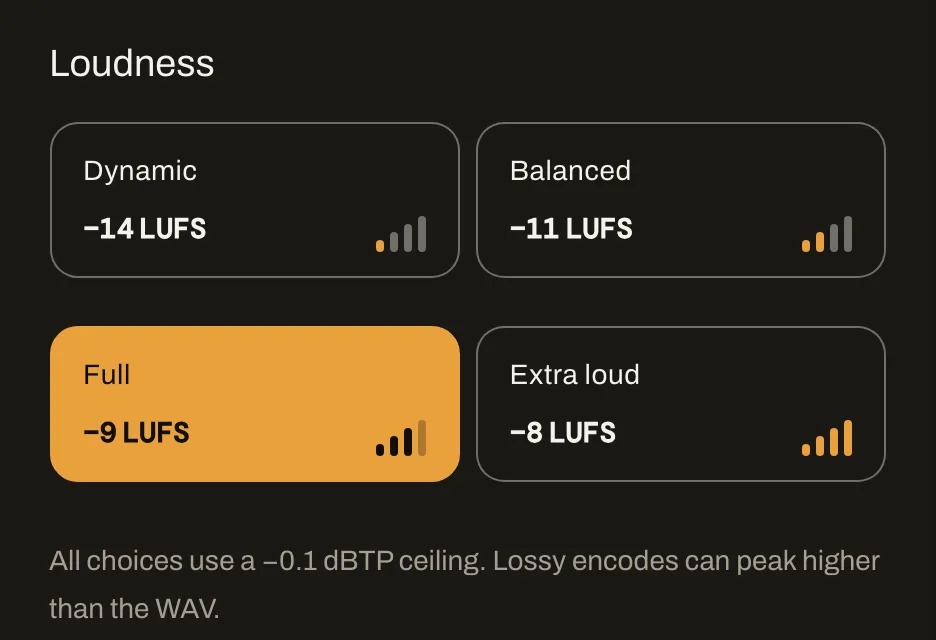
Loudness is brought to the target you chose and the true-peak ceiling is enforced on the way out. Three files are written: the 24-bit master at your source sample rate, a 16-bit 44.1 kHz version, and an MP3 at 320 kbps.
Choose Dynamic (−14 LUFS), Balanced (−11 LUFS), Full (−9 LUFS), or Extra loud (−8 LUFS). All use −0.1 dBTP. Lossy encodes can peak higher than the WAV.
Technical reference: 17 supported delivery presets, including saved legacy targets
New uploads offer the four loudness choices above: Full (the default row) and streaming-tp01, loud-11-tp01 and loud-8-tp01 below. The other presets remain supported for saved jobs and retries, including their original output formats.
Scrolls sideways →
Preset Loudness Ceiling Notes Full · default −9 LUFS −0.1 dBTP Current upload choice; source sample rate, 24-bit. streaming −14.0 LUFS −1.0 dBTP Source sample rate, 24-bit loud-11 −11.0 LUFS −1.0 dBTP Above the streaming target; meets AES TD1008’s −1 dBTP loud-95 −9.5 LUFS −1.0 dBTP Legacy loud target loud-8 −8.0 LUFS −1.0 dBTP Loud; the limiter does real work streaming-tp20 −14.0 LUFS −2.0 dBTP The −2.0 dBTP ceiling is Spotify’s recommendation for a master louder than −14 LUFS, because “louder tracks are more susceptible to extra distortion when encoded for streaming.” It is not the default — ours is −9 / −0.1, which trades that guidance for the peak room a punchier master needs. loud-11-tp20 −11.0 LUFS −2.0 dBTP loud-95-tp20 −9.5 LUFS −2.0 dBTP loud-8-tp20 −8.0 LUFS −2.0 dBTP streaming-tp01 −14.0 LUFS −0.1 dBTP The −0.1 dBTP ceiling keeps the most peak room, and every current upload choice uses it. It sits above AES TD1008 §4, which recommends not exceeding −1 dBTP at the input of a lossy encoder, and §7 notes the margin may need to grow as bitrate falls. Expect MP3 and streamed versions to peak higher than the WAV. loud-11-tp01 −11.0 LUFS −0.1 dBTP loud-95-tp01 −9.5 LUFS −0.1 dBTP loud-8-tp01 −8.0 LUFS −0.1 dBTP apple −16.0 LUFS −1.0 dBTP Named for Apple Music, which publishes a −1 dBTP requirement and no LUFS figure club −7.0 LUFS −0.5 dBTP Loud systems cd −9.0 LUFS −0.3 dBTP 16-bit 44.1 kHz vinyl peak-normalised −1.0 dBTP No limiter; lows summed below 120 Hz -
Measure the file that will be delivered
Every rendered file is decoded and checked again, for length and for invalid samples. Both WAVs are held to the true-peak ceiling, and the 24-bit WAV’s loudness is checked against the target, or against what mastering reached when the target was out of reach. That catches a botched resample or a corrupted render before it is offered. The MP3’s true peak is measured, not held to the ceiling.
If the mix could not reach the target without passing the ceiling, the file is still delivered — at the loudest level that stays compliant — with the shortfall stated in LU. The ceiling is never traded away, because the ceiling is the reason the target was out of reach.
Checks on a delivered test master (−9.06 LUFS against a −9 target), staging File True peak Against −0.1 dBTP 24-bit WAV −0.39dBTP Held 16-bit 44.1 kHz WAV −0.33dBTP Held MP3 320 −0.26dBTP Measured
Two measurements
Two measurements.
Every finished job carries two sets of numbers, one for your mix and one for the master, and they are always labelled.
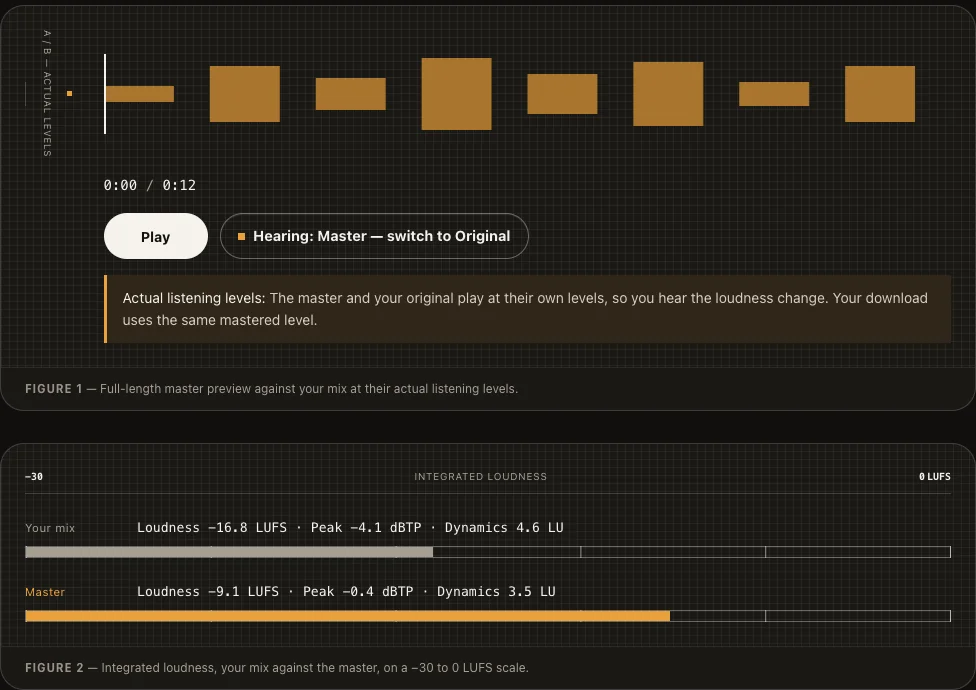
What arrived. Useful for judging the mix — whether it has headroom, whether it is already squashed, whether the low end is carrying more than its share.
What you are about to download. This is the number that matters for release, and it is measured on the actual rendered file, not predicted from the settings.
Specifications
What goes in, and what comes out.
- WAV, AIFF, FLAC, MP3
- Up to 12 minutes, or 6 above 48 kHz
- Mono or stereo mixes, 44.1 to 96 kHz; the 24-bit master keeps your sample rate; a mono mix comes back as a two-channel master
- 24-bit WAV at the source rate
- 16-bit 44.1 kHz WAV
- MP3 320 kbps
- One curated master, the same for every job
- A finished master from the engineer’s own catalogue
- Chosen for you — nothing to set
Questions
Questions about the chain
How long does a master take?
Most tracks finish in 1–5.5 minutes. The five stages run in the same order every time.
Do I have to pick a delivery target?
No. The default is −9 LUFS at a −0.1 dBTP ceiling. Choose Dynamic, Balanced, Full or Extra loud to suit your track. Lossy encodes can peak higher than the WAV.
What happens if my mix cannot reach the target?
It delivers what it reached without breaching the ceiling, and states the shortfall on the job page. The ceiling is never traded for loudness.
Which numbers am I looking at?
Two sets. One is measured on the file as it arrived, before anything was touched; the other on the file you download. They are labelled separately everywhere they appear.
Can I run the same track again?
Yes, at a different target. The preview is free every time, up to 20 masters a day on the free tier. On Unlimited the new master is included; per track, each master you download is its own purchase.
What can I upload?
WAV, AIFF, FLAC or MP3, mono or stereo, 44.1 to 96 kHz, up to 1 GB and 12 minutes (6 minutes above 48 kHz). You get 24-bit WAV, 16-bit WAV and MP3 320 back on every paid level.
The same chain, every track
The same five stages on every track.
Start with a track you already know.
The preview is free and full length. The master plays at its delivered level and your original at its own, so you hear the loudness change along with everything else.